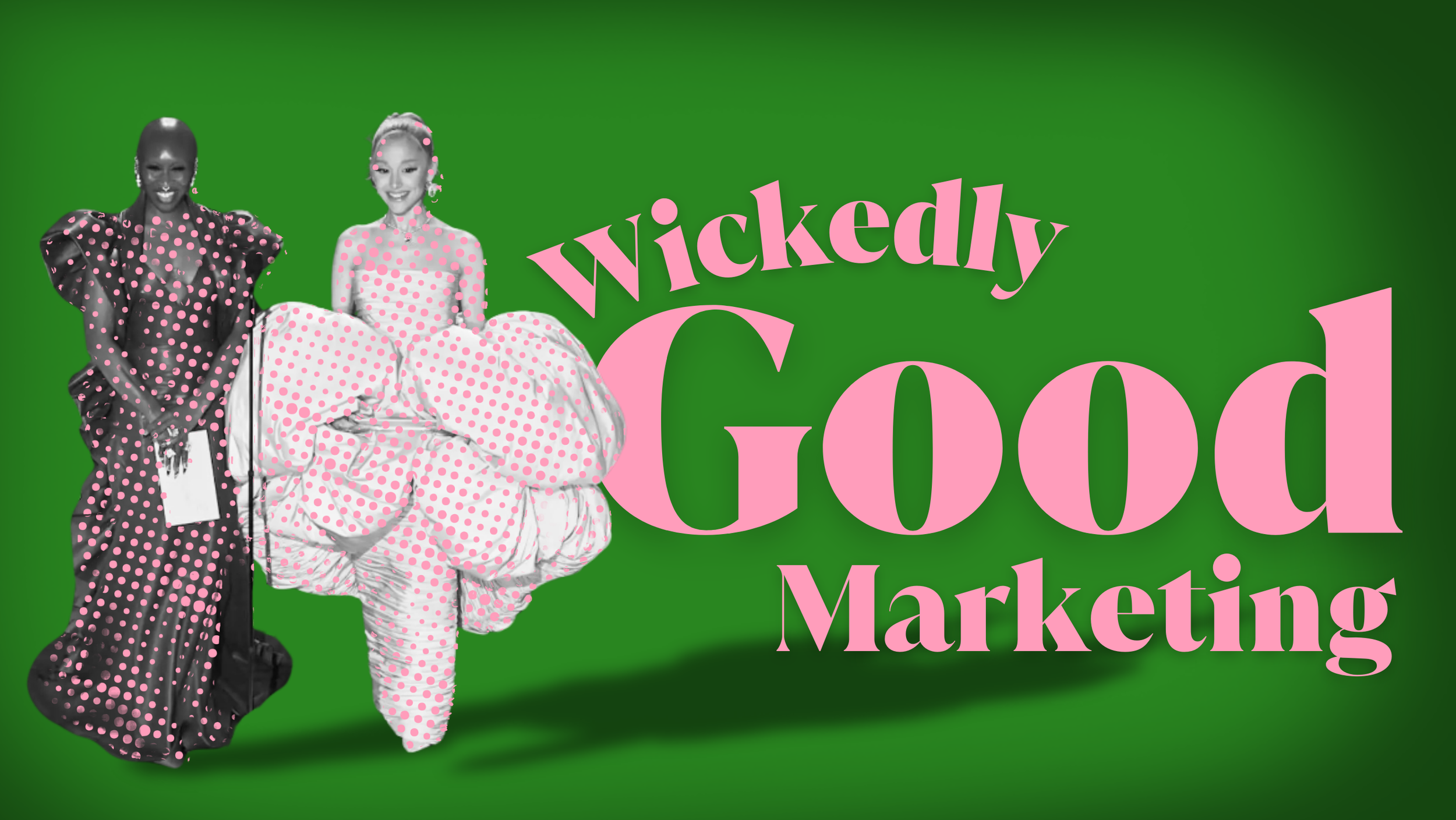
Wicked parts 1 and 2 have taken over the world–from sold-out theaters to grocery stores, and even your favorite restaurants–giving both musical lovers and newcomers a taste of magic, girlhood, and a sprinkle of nostalgia spanning across generations. This Broadway adaptation tells a story that portrays othering and propaganda, making it feel especially timely as a reminder of our shared humanity and questions of power and belonging. The marketing team didn’t miss a beat. Here’s how the campaign wove those themes into an inclusive cultural takeover, becoming the biggest Broadway adaptation of all time… without the spoilers!
Setting the Stage
Wicked opened on Broadway in 2003 as a prequel to The Wizard of Oz, following the story of how Glinda becomes the “Good Witch” and how Elphaba is ultimately branded as “Wicked.” The show quietly primes us for two key ideas: othering and propaganda. Othering happens when someone is cast as fundamentally different or “less than,” making it easier for people to justify exclusion, blame, or fear. Elphaba’s green skin, magical powers, and refusal to fit in make her an easy scapegoat. The Wizard, who possesses no magical power, spins his propaganda to control the narrative, turning Elphaba into a public enemy, while keeping Oz in line. These themes open the door to deeper conversations about power and perception.
The Campaign and Inclusion Marketing
The marketing behind Wicked the movie was on the same cultural scale as Barbie. Universal executed a full saturation strategy, partnering with 450 promotional brands to support the film’s 2024 premiere and generating an estimated $350 million in media value. This approach didn’t just build excitement in the months leading up to release; it made Wicked completely unavoidable. From Super Bowl commercials and beauty collaborations to Stanley cups and Swarovski jewelry, the campaign broadened the audience with strategic partners, reaching 2 billion shoppers and 25 billion global impressions. Talk about a worldwide audience. Whether you’re walking through a mall or scrolling social media, Glinda and Elphaba’s pink and green were everywhere, turning Wicked into a full-blown cultural reference point.
From there, brand marketers built in smart inclusion tactics that stepped beyond the Wicked plot itself. They leaned into social campaigns around reaction videos and fan theories, inviting people to engage and co-create the hype together. They made sure there were accessible options so more fans could join in.
Casting played a huge role. With two powerhouse women, Ariana Grande and Cynthia Erivo, at the center, the film had two massive social followings fueling the buzz. Erivo’s casting carried an added layer of meaning as a queer Black woman playing Elphaba. She brought real‑world visibility to the story’s themes of othering. Her presence made the narrative hit differently, highlighting how quickly society labels someone as “other,” and how identity shapes who gets villainized, celebrated, or believed. Marissa Bode, who uses a wheelchair, portrayed Nessarose, marking the first time a disabled actor has played the role on screen. That choice wasn’t just symbolic; it expanded who gets to be seen in major fantasy worlds and who gets to take up space in blockbuster storytelling. It also reminded audiences that accessibility isn’t an afterthought but part of the story. Because the loyal fan base spans generations — from the 1939 Wizard of Oz to the 2003 Broadway hit to the 2024 film — inclusion became a consistent throughline. It appeared in every part of the marketing ecosystem from who was cast, who was invited into the conversation, and how fans were encouraged to participate.
Wicked Mirroring Reality
Wicked arrived at a moment when its themes of scapegoating and narrative control feel especially familiar. The story taps into the way fear-mongering, propaganda, and manufactured enemies get used to keep people in line. Green skin becomes a stand-in for any real-world difference that power structures latch on to, acting as a subtle but powerful mirror of the us vs. them mentality.
On the surface, the marketing leaned into glittery escapism and feel-good vibes, but fans still picked up on the deeper currents. The story naturally invited people to connect the dots around themes of diversity, equity, inclusion, and accessibility. It’s a reminder that even glossy campaigns can quietly invite us to reflect about our own world.
Wicked is a blueprint for how inclusion can move from messaging to actual infrastructure. Its success shows that equity isn’t niche, it scales. When brands design for participation, not just impressions, inclusion becomes a growth driver instead of a risk. Fandom-driven content and intentional casting gave audiences ways to see themselves in the campaign.
Wicked didn’t just tell a story about power and belonging; it modeled how brands can shape culture more responsibly. Marketers can create something commercially massive and still humanizing that spans identities, generations, and communities.